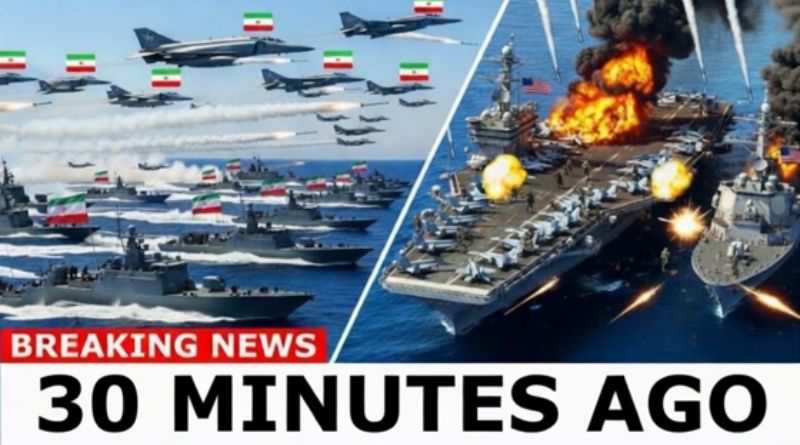
In an era when geopolitical tensions often simmer beneath the surface, the naval strength of the United States continues to act as a powerful deterrent against potential threats. Few symbols represent that strength more clearly than a modern aircraft carrier. But what might happen if that power were suddenly challenged by a coordinated assault? Imagine a scenario in which 25 fast attack boats and 18 fighter jets launch a simultaneous strike on the USS Abraham Lincoln (CVN-72). While entirely fictional, such a situation reflects real-world combat principles and offers insight into the complexity of modern naval warfare.
The USS Abraham Lincoln (CVN-72), a Nimitz-class aircraft carrier, operates as a floating fortress at sea. Equipped with advanced radar systems, layered defenses, and a highly trained crew, the carrier’s role is to project power and safeguard freedom of navigation. Yet even the most capable warships must remain alert when operating in high-risk environments. As the carrier strike group enters contested waters, tension builds. Iranian forces, known for emphasizing asymmetric naval tactics, deploy fast attack boats racing across the waves while fighter jets climb into the sky. The objective is clear: overwhelm the carrier’s defenses by striking simultaneously from sea and air. The moment the threats appear on radar, the U.S. Navy’s defensive network springs into action. Automated systems track incoming targets as sailors move quickly to battle stations. One key component of the carrier’s close-range defense is the Phalanx CIWS, a rapid-fire gun designed to intercept fast-moving threats before they reach the ship.
At the same time, aircraft roar from the flight deck. Boeing F/A-18E/F Super Hornet fighters climb rapidly into the sky to intercept incoming aircraft and protect the carrier group. The airspace quickly becomes a high-stakes battlefield as pilots rely on training and precision to outmaneuver their opponents. As the engagement unfolds, the U.S. Navy’s layered defense demonstrates its effectiveness. Although fictional, this scenario highlights the complexity of modern warfare and the importance of constant readiness at sea. Ultimately, the true strength of the fleet lies not only in advanced technology, but also in the discipline and professionalism of the sailors who operate it.