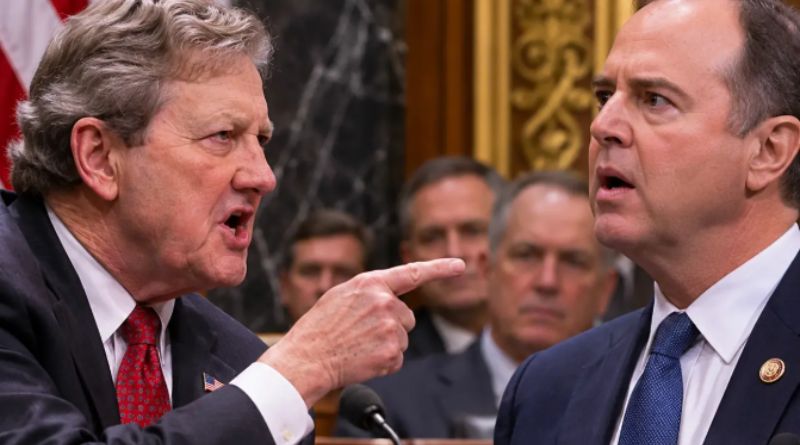
A dramatic political story involving Republican Senator John Neely Kennedy and Democratic Senator Adam Schiff has attracted attention online, raising questions about a supposedly heated confrontation between two prominent American lawmakers.
The circulating narrative claims that Schiff insulted Kennedy’s Southern background during a congressional exchange, prompting an extraordinary response that allegedly left the California senator unable to answer his Republican colleague.
According to the sensational account, the confrontation began during a tense discussion on Capitol Hill, where disagreements over political conduct and congressional accountability supposedly escalated into a deeply personal argument.

The most provocative element involves a quotation attributed to Schiff, who allegedly described Kennedy as an “ignorant Southern hick” before receiving a pointed response about education and regional stereotypes.
However, an essential distinction must be established before examining the controversy: the alleged insult, the dramatic rebuttal, and the supposed stunned silence have not been independently verified.
An online account published in October 2026 repeats the confrontation narrative while acknowledging that the central dialogue and reactions lack supporting evidence from authenticated recordings or reliable contemporaneous reporting. <Cite ref=”turn418295search0″/>
That uncertainty is especially important because the story presents detailed descriptions of congressional proceedings without establishing the precise hearing, official transcript, or complete recording needed to confirm the alleged exchange.
The account nevertheless offers an opportunity to examine broader questions about political rhetoric, regional identity, educational assumptions, and the responsibilities of elected officials when participating in contentious public debates.
John Neely Kennedy represents Louisiana in the United States Senate and is known for a conversational speaking style that frequently incorporates humor, colorful expressions, and pointed criticism of political opponents.
Adam Schiff represents California in the Senate and has been a prominent figure in national political debates, particularly those involving congressional oversight, presidential accountability, and disputes over institutional authority.
Their political differences reflect broader disagreements between Republicans and Democrats about federal government responsibilities, the interpretation of political accountability, and the standards governing public officials’ conduct.
The alleged confrontation builds upon those recognizable differences, portraying Kennedy as defending his regional identity while Schiff supposedly questions the seriousness or sophistication of his political arguments.
Yet the narrative’s emotional appeal should not be confused with evidence that the described encounter occurred exactly as claimed, regardless of how widely the headline circulates online.
The story suggests that Kennedy’s Southern accent became the central subject of the confrontation, transforming what supposedly began as a procedural disagreement into an argument about intelligence and cultural stereotypes.
Such an accusation would carry significant implications because regional accents do not provide a reliable measure of someone’s education, professional qualifications, or ability to evaluate complicated political questions.
Americans speak with a wide variety of accents shaped by geography, family history, community traditions, and personal experiences, none of which independently determines an individual’s intellectual abilities.
The Southern United States includes major universities, research institutions, professional organizations, and communities whose contributions extend across science, medicine, law, technology, business, education, and public service.
Reducing people to assumptions based on their accents can obscure their actual qualifications and distract from the substance of the arguments they present in professional or political settings.
The circulating account attempts to dramatize that principle by portraying Kennedy as answering the alleged insult through references to his academic credentials and professional background.
Kennedy’s educational history is publicly documented, but that biographical information cannot establish that he delivered the particular speech attributed to him in the viral political narrative.
This distinction matters because a story can contain accurate background details while still presenting an invented or unverified confrontation involving recognizable individuals and plausible political disagreements.
The online account describes Kennedy responding with remarks about education, working Americans, and the importance of judging arguments according to evidence rather than appearances or regional identity.
Those themes are understandable subjects for political discussion, but the exact wording attributed to Kennedy requires independent confirmation before it can be treated as an authentic congressional statement.
The narrative also claims that Schiff was left speechless, an interpretation that would require reliable footage or a verified transcript establishing what happened immediately after the alleged response.
Without such evidence, describing either politician as victorious, humiliated, or defeated would turn an unverified storyline into an unsupported judgment about an actual political encounter.
The difference between political storytelling and documented reporting becomes especially important when dramatic headlines are designed to create the impression that a confrontation has been conclusively resolved.
A phrase such as “left him speechless” suggests that one participant delivered an argument so decisive that the other could no longer provide a meaningful response.
But silence, even when documented, can have many explanations, including procedural interruptions, limited speaking time, transitions between speakers, or a decision not to continue an exchange.
Consequently, claims about a politician’s reaction should be supported by observable evidence rather than inferred from dramatic descriptions intended to increase attention or encourage partisan reactions.
The same principle applies to claims that an audience erupted, lawmakers appeared shocked, or a congressional hearing suddenly became silent after a particularly memorable statement.
Such details can make a political story entertaining, but they also create an impression of firsthand observation that may not be justified by the available source material.
In the Kennedy-Schiff narrative, the absence of independently authenticated documentation leaves those theatrical elements unconfirmed, despite the confident language used in some versions of the story.
The controversy illustrates how recognizable political personalities can become characters in narratives that closely resemble actual congressional exchanges while lacking the evidence required for factual reporting.
Kennedy’s public speaking style makes him a plausible subject for stories involving memorable verbal responses, particularly when those stories emphasize humor, directness, or challenges to political opponents.
Schiff’s visibility in national debates likewise makes him a recognizable figure in political narratives involving congressional investigations, partisan disagreements, and disputes over public accountability.
Those recognizable characteristics can make an invented or embellished confrontation appear credible, especially when readers encounter the account without additional information about its original source.
The alleged exchange also touches upon a longstanding tension between political presentation and political substance, particularly when public officials use distinctive communication styles to reach different audiences.
A conversational speaking style may make complicated subjects more accessible, but it does not automatically establish that the speaker’s arguments are accurate or supported by sufficient evidence.
Similarly, formal language and advanced academic credentials do not guarantee that a political position is correct, because policy disagreements must ultimately be evaluated through evidence and reasoning.
The strongest standard is therefore consistent: assess what a politician says, examine the supporting evidence, and consider the practical consequences of the position being defended.
That approach avoids assuming that either a regional accent or an elite educational background determines the quality of an individual’s contribution to a political discussion.
It also provides a more useful framework for examining the underlying disagreements between lawmakers whose political priorities and interpretations of government responsibility may differ substantially.
Political disagreements frequently involve competing assessments of federal spending, oversight powers, constitutional responsibilities, and the appropriate balance between national authority and individual rights.
Those disagreements deserve careful attention because congressional decisions influence public services, economic policy, legal protections, and the functioning of government institutions across the United States.
When debates shift toward personal insults, audiences may become more interested in which politician delivered the most memorable line than in understanding the issue originally under discussion.
That shift can benefit attention-driven political content while leaving citizens with limited information about the legislation, evidence, or procedural decisions that prompted the disagreement.
The alleged Kennedy-Schiff confrontation provides an example of this problem because the circulating headline emphasizes humiliation and verbal dominance without establishing a verifiable legislative context.
A reader encountering the story might reasonably ask where the exchange happened, what committee was meeting, which subject was being examined, and whether an official transcript exists.
Those questions are not minor technicalities. They provide the foundation for distinguishing an authentic congressional confrontation from a fictionalized account designed around recognizable political figures.
Official congressional records, complete hearing recordings, and credible contemporaneous reporting can help establish whether a quotation was spoken and whether the surrounding description accurately reflects events.
Short excerpts may also require context, because an isolated remark can carry a different meaning when separated from the question, response, or procedural discussion that originally surrounded it.
For that reason, verification should examine the complete exchange whenever possible rather than relying exclusively on dramatic captions, edited clips, or descriptions provided by partisan commentators.
The available search results also identify separate, documented occasions when Kennedy criticized Schiff or commented on arguments associated with his political work, particularly during earlier congressional controversies.
Those historical disagreements should not be merged into the alleged Southern-insult confrontation, because the existence of earlier criticism does not prove that a later viral story occurred. <Cite refs={[“turn418295search1″,”turn418295search3”]}/>
The distinction is particularly important when political content combines real biographies, genuine partisan tensions, and unsupported dialogue into a single narrative presented as a dramatic public event.
Readers may recognize the politicians and remember previous disagreements, making the new story appear consistent with what they already know about their public identities.
However, familiarity is not confirmation, and a plausible narrative still requires evidence before its specific claims can be presented as established facts.
The broader debate about regional identity remains relevant even without proof that Schiff made the reported insult or that Kennedy delivered the attributed response.
Regional stereotypes have influenced American cultural and political discussions for generations, sometimes encouraging unfair assumptions about individuals based on speech patterns, geographic background, or community traditions.
Such assumptions can distract from the actual qualifications and responsibilities of elected representatives, whose decisions should be evaluated according to their conduct, arguments, and public records.
Kennedy’s political identity includes his representation of Louisiana, while Schiff’s public career is closely associated with California and national debates over congressional oversight.
Their different backgrounds may influence how they communicate with constituents, but those differences do not justify treating either lawmaker’s geographic identity as evidence of intellectual superiority.
The alleged confrontation therefore raises a useful question about whether public debate should prioritize arguments and evidence rather than stereotypes about where an individual comes from.
That question applies across political affiliations because personal attacks can weaken the quality of discussion regardless of which party or public official is responsible for delivering them.
Criticism of government policy remains an essential part of democratic accountability, and lawmakers must be free to challenge one another’s positions with substantial arguments and relevant evidence.
But criticism becomes less informative when it substitutes assumptions about personal identity for examination of the policies, decisions, or actions that are actually being disputed.
The public benefits when disagreements are specific enough to be evaluated, allowing citizens to understand what each politician proposes and why those proposals may have different consequences.
In contrast, an argument framed primarily as a personal victory can encourage audiences to celebrate a rhetorical performance without considering whether the underlying claims are accurate.
The Kennedy-Schiff narrative is particularly dependent on that competitive framing, presenting one politician as supposedly arrogant and the other as delivering an overwhelming response.
Yet those characterizations are part of the circulating account rather than conclusions established by an authenticated recording or reliable documentation of the alleged confrontation.
A responsible interpretation therefore separates the story’s emotional structure from the facts that can currently be supported through publicly accessible records and credible reporting.
The alleged insult remains unverified, the lengthy rebuttal remains unverified, and the claimed reaction inside the hearing room remains unverified in the available material.
What can be discussed with greater confidence is the broader issue of how political rhetoric influences public understanding and shapes perceptions of elected officials.
Modern political communication increasingly takes place across television, online video platforms, and social networks, where short, memorable statements can circulate independently of their original context.
These formats can help citizens discover important political developments, but they can also reward emotionally charged descriptions that provide little information about the underlying evidence.
A dramatic headline may reach audiences who would otherwise ignore a congressional hearing, yet that attention becomes less useful when the event itself cannot be reliably documented.
The challenge for readers is to distinguish between political commentary, fictional entertainment, satire, and reporting that establishes its claims through identifiable sources and verifiable records.
That distinction becomes especially difficult when an account uses realistic settings, familiar politicians, and detailed descriptions of gestures, audience reactions, or procedural developments.
A story may sound like a television transcript without actually being derived from one, particularly when it includes dialogue that has not been matched to an authenticated recording.
The presence of precise quotations can strengthen the illusion of accuracy, even though quotation marks alone do not establish that the words were spoken by the person identified.
The alleged insult attributed to Schiff illustrates that problem because its memorable wording encourages immediate emotional reactions before readers have established whether the quotation is genuine.
Similarly, the response attributed to Kennedy encourages admiration for a supposed rhetorical achievement without providing independent evidence that the described speech occurred during an actual hearing.
Political audiences deserve better than uncertainty presented as certainty, particularly when the claims concern identifiable individuals whose reputations may be affected by widely circulated allegations.
This does not mean that every unverified political story must be dismissed without examination, but it does require appropriate caution about the conclusions readers draw.
When evidence is incomplete, the accurate description is that a claim is circulating and remains unconfirmed, not that the alleged event has been definitively established.
The distinction protects the integrity of public debate by allowing genuine disagreements to receive attention without adding unsupported statements to the historical record.
It also encourages more substantive discussion about what elected officials actually say and do, rather than what dramatic narratives suggest they might have said.
For Kennedy, his public record and documented statements provide a stronger basis for understanding his political approach than an unverified story about a supposed verbal confrontation.
For Schiff, his actual speeches, legislative positions, and recorded statements provide a more reliable foundation for evaluating his conduct than a quotation circulating without independent confirmation.
Neither politician’s public responsibilities can be adequately assessed through a single sensational headline, especially when the headline’s central event remains unsupported by authenticated evidence.
The larger issue is whether citizens can maintain a clear distinction between compelling political narratives and the documented information necessary for informed public judgment.
That distinction matters regardless of party affiliation because misinformation and unsupported allegations can distort perceptions of political opponents and complicate efforts to discuss legitimate policy disagreements.
The alleged confrontation may continue attracting attention because its storyline combines recognizable personalities, regional identity, political rivalry, and the promise of a dramatic rhetorical reversal.
But the strength of that storyline does not resolve the central factual question: whether Schiff made the alleged remark and Kennedy responded as the circulating account describes.
Based on the material reviewed, that specific exchange has not been independently established, and the most dramatic details should not be repeated as verified congressional history.
The episode nevertheless highlights the importance of respectful disagreement, careful sourcing, and the consistent evaluation of political arguments according to evidence rather than stereotypes or theatrical presentation.
Citizens can strongly disagree about the positions of Kennedy and Schiff while still expecting accurate descriptions of their statements and fair treatment of their documented public conduct.
Ultimately, the most meaningful political question is not whether one senator supposedly left another speechless, but whether public discussion helps voters understand the issues affecting their lives.
Until reliable documentation emerges, the alleged Southern-insult confrontation remains an unverified political narrative, not a confirmed Capitol Hill exchange between John Neely Kennedy and Adam Schiff.