A curious theory circulating online has captured attention by suggesting that Donald Trump and his son, Barron Trump, could somehow be time travelers. While the idea is far-fetched, it has gained momentum due to a series of unusual coincidences drawn from historical art and literature.
Donald Trump has undeniably lived a highly unconventional life. After earning a degree in economics, he joined his father’s real estate business and gradually built a global brand. Later, he became a household name through television as the host of The Apprentice. In a surprising political shift, he entered the 2016 presidential race and went on to win, becoming one of the most controversial figures in modern American politics.
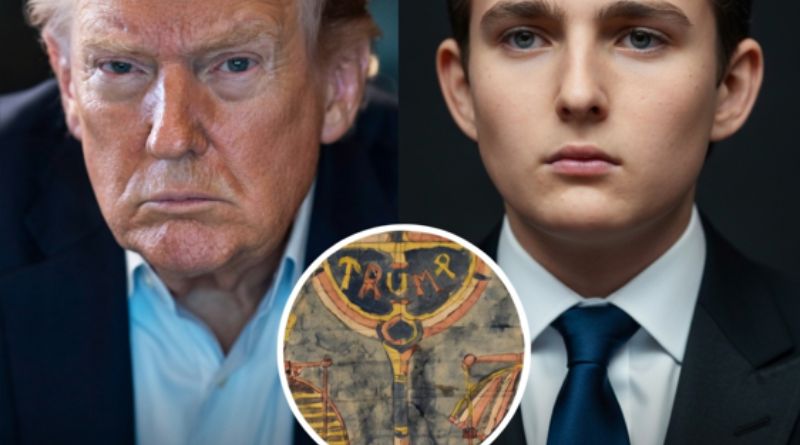
Recently, however, attention has shifted away from his political career and toward a bizarre theory linking him to time travel. The idea gained traction after people revisited the work of Charles Dellschau, a Prussian-born artist who died in 1923. Dellschau created detailed sketches of fantastical flying machines called “aeros,” many of which included strange annotations and symbols. Some viewers claim that certain drawings appear to feature the word “TRUMP,” along with imagery that loosely resembles a blonde figure piloting a craft marked with the number 45—coincidentally the number associated with Trump as the 45th president.
In addition, Dellschau’s references to mysterious fuels like “NB Gas” or “supe” have intrigued UFO enthusiasts, who argue that his work may hint at advanced or even futuristic technology. These interpretations have fueled speculation that the drawings somehow connect to modern discussions about unidentified aerial phenomena.
The theory doesn’t stop there. Internet sleuths have also pointed to a series of books written in the 1890s by author Ingersoll Lockwood. These stories center around a young boy named Baron Trump, who lives in a place called Castle Trump and embarks on adventures guided by a mentor named Don. The similarities in names to Barron and Donald Trump have led some to believe the books are more than mere fiction.
One of Lockwood’s works, The Last President, has drawn particular attention. It describes political unrest in New York following a controversial election, including protests and upheaval in areas like Fifth Avenue. Some readers claim these elements mirror modern political events closely enough to suggest a kind of prediction. Others have even attempted to connect characters in the story to real-life political figures, though such links are often vague and speculative.
Further adding to the intrigue is the fact that Trump’s uncle, John G. Trump, was an MIT professor who examined the papers of inventor Nikola Tesla after his death. Tesla’s reputation for visionary ideas has led some conspiracy theorists to speculate—without evidence—that his work may have involved time travel or advanced technologies.
Despite the excitement surrounding these claims, most explanations are far more grounded. Historians note that Dellschau’s writings are difficult to interpret and often misread. Similarly, the names and themes found in Lockwood’s books were not unusual for the time and can be explained by common literary conventions.
Ultimately, the theory persists because of the human tendency to find patterns and meaning in coincidences. While the connections may seem intriguing at first glance, there is no credible evidence to support the idea that Donald Trump or his son are time travelers. Instead, the story serves as a fascinating example of how easily imagination and coincidence can combine to create compelling—but unlikely—narratives.