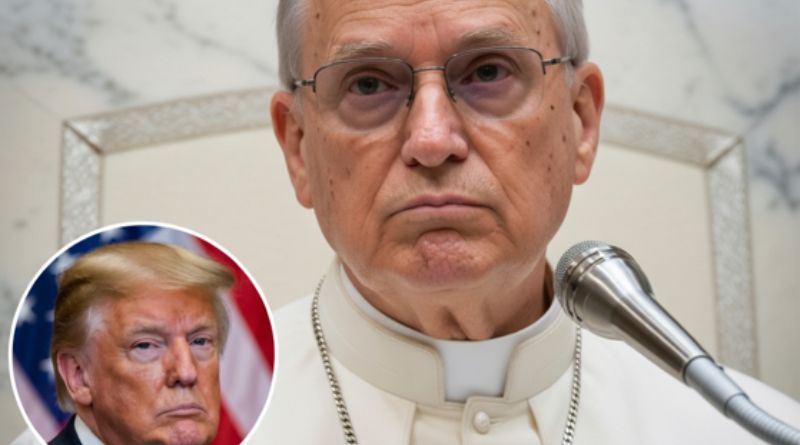
In an era dominated by the constant roar of 24-hour news cycles and the over-explained pronouncements of political figures, the most striking statement of the year arrived not as a speech, but as a whisper. Pope Leo XIV, successor to a lineage of spiritual leaders, captured global attention with a single, viral word in response to a question about the fractures within American society: “Many.” In a world of noise, this one word carried the weight of a mountain, signaling the emergence of a papacy that is impossible to ignore and difficult to categorize.
The choice of “Many” was no casual deflection. It served as a mirror for a nation wrestling with deep divisions, economic upheaval, and an increasingly volatile political landscape. By refusing platitudes or partisan talking points, Leo XIV signaled that his papacy would be marked by moral seriousness and an unwillingness to be confined by the reductive labels of modern discourse. The word functioned as both a subtle rebuke to those seeking simple solutions and an invitation to reflection. It announced that the Holy See is watching—not as a distant spectator, but as a shepherd attuned to the scale of human struggle.
This approach aligns with the trajectory of the man formerly known as Cardinal Robert Francis Prevost. Before ascending to the Chair of St. Peter, Prevost established himself as a vocal advocate for social justice, immigration reform, and the dignity of the marginalized. He challenged the hardline policies of the Trump administration on migrant rights and the treatment of the vulnerable, but his recent public statements reveal a more nuanced stance than simple political opposition. Leo XIV embodies a blend of moral clarity and engagement, refusing to bow to the expectations of left or right.
In the current global landscape, Leo XIV occupies a singular position. He has critiqued the rhetoric of the nationalist right while remaining critical of the Democratic Party on issues of life and economic justice. Resisting ideological packaging, he echoes the philosophy of his namesake, Leo XIII, who balanced labor rights with personal ownership in the landmark encyclical Rerum Novarum. Leo XIV approaches social ethics with intellectual rigor, recognizing that the “many” challenges of the world cannot be solved through singular political dogma but require a fundamental shift in our view of obligations to one another.
The viral resonance of “Many” also underscores a shift in Vatican communication strategy. In an age where attention is currency, Leo XIV distilled complexity into a single word, forcing social media audiences to ask: “Many what?” Many voices? Many sorrows? Many opportunities for redemption? This deliberate ambiguity, influenced by Jesuit pedagogy, invites active engagement and meaning-making. It is pastoral work performed on a digital stage, marking Leo XIV as a force on the international scene.
The timing of this message is especially poignant given tensions in the Middle East and between the United States and Iran. While leaders speak in terms of “total obliteration,” the Pope speaks to the human cost of conflict, emphasizing the interconnected web of lives imperiled by violence. His advocacy for immigration, too, is theological, not merely political: the “many” includes migrants at borders, rust belt workers, families affected by war, and those quietly struggling in daily life.
Reactions have been mixed. For some, “Many” offered comfort—a recognition that their struggles are seen. For others, it was unsettling, a reminder that the Church will hold a mirror to collective failings. Critics have dismissed it as a gimmick, but Leo XIV’s decades of ecclesiastical and social service prove otherwise.
As 2026 unfolds, it is clear that this papacy refuses to be ignored. Whether in a single word on social media or a sweeping encyclical on labor and the environment, Leo XIV demands attention to the nuances of the human condition. His whisper of “Many” may be remembered as the moment he fully assumed his role as a global provocateur, signaling that the Church will be a voice of moral accountability in Washington, Tehran, Stockton, and beyond.