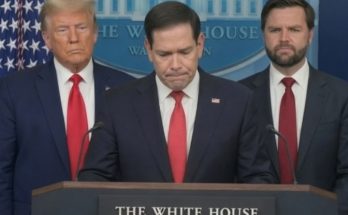
President Donald Trump voiced strong dissatisfaction with Iran’s reported decision to appoint Mojtaba Khamenei as the new supreme leader following the death of his father, Ayatollah Ali Khamenei, who was reportedly killed in an airstrike at the beginning of Operation Epic Fury. Trump said he does not believe Mojtaba Khamenei “can live in peace,” and suggested that early results from U.S. military operations have exceeded expectations. He described the joint U.S. and Israeli campaign in Iran as progressing “way beyond expectation” at this stage.
In a post on Truth Social, Trump warned that Iran would face significantly stronger military action if it attempted to disrupt oil shipments through the Strait of Hormuz. He added that the United States could target key infrastructure in ways that would make it extremely difficult for Iran to rebuild, while also stating that he hoped such escalation could be avoided. According to U.S. Central Command (CENTCOM), Operation Epic Fury began on February 28 and initially targeted thousands of sites, including military and strategic infrastructure. These reportedly included command centers, Islamic Revolutionary Guard Corps (IRGC) facilities, intelligence locations, air defense systems, missile sites, and naval assets.
In a later update, Secretary of War Pete Hegseth described the campaign as “highly successful,” claiming that more than 7,000 targets across Iran had been struck. He stated that Iran’s military capabilities—including missile production, air defenses, and naval forces—had been significantly degraded. Hegseth also said that attacks against U.S. forces, including ballistic missile launches and drone strikes, had decreased sharply since the start of the conflict. He emphasized that while Iran retains some ability to respond, its capacity has been substantially reduced. He further argued that the campaign was aimed at limiting Iran’s military and strategic capabilities, particularly those linked to missile development and regional influence.
WATCH: