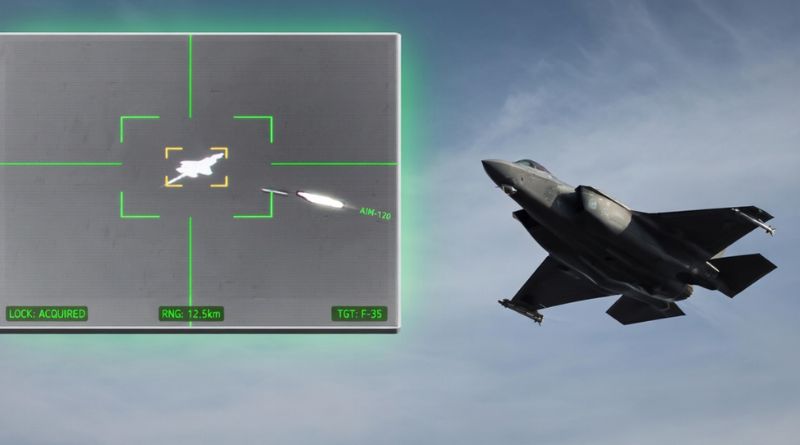
Iran has publicly announced that it successfully struck a U.S. F-35 stealth fighter, causing damage and forcing it to make an emergency landing at a U.S. military base in the region. This is the first time Iran has officially claimed to intercept an F-35 during ongoing hostilities, marking a significant escalation in the conflict. The Islamic Revolutionary Guard Corps (IRGC) stated that it used advanced air defense systems over central Iran to target the fighter jet. The engagement reportedly occurred at 2:50 a.m. local time on Friday, March 20, 2026. In an official statement, the IRGC said, “The fate of this fighter jet is not yet fully confirmed and remains under investigation, but the probability that it was downed is very high.”
The IRGC also reported intercepting 125 long-range drones launched by the United States and Israel during the ongoing conflict. The missile used to target the F-35 is believed to be the SA-67, also known as Missile 358, a domestically produced Iranian surface-to-air missile first deployed in the late 2010s. This missile combines conventional anti-aircraft technology with the capability to engage long-range drones. According to defense analysts, the SA-67 has been designed to remain airborne for extended periods, allowing it to track and engage high-value targets effectively. Its combination of speed, precision, and endurance makes it capable of striking both manned and unmanned aircraft at significant distances.
This announcement follows a period of heightened tensions in the region, with Iran and U.S. forces continuing to clash amid a broader conflict involving multiple regional actors. While independent verification of the F-35’s status has not yet been confirmed, the IRGC’s statement reflects Tehran’s growing confidence in its air defense capabilities and its willingness to publicize successful strikes against high-value U.S. military assets. The reported downing of the F-35, if verified, would represent a rare and notable loss for the United States, given the jet’s advanced stealth technology and combat capabilities. It also underscores the increasing risks faced by aircraft operating in contested airspace over and around Iran, as both manned and unmanned systems continue to play a central role in the ongoing hostilities.