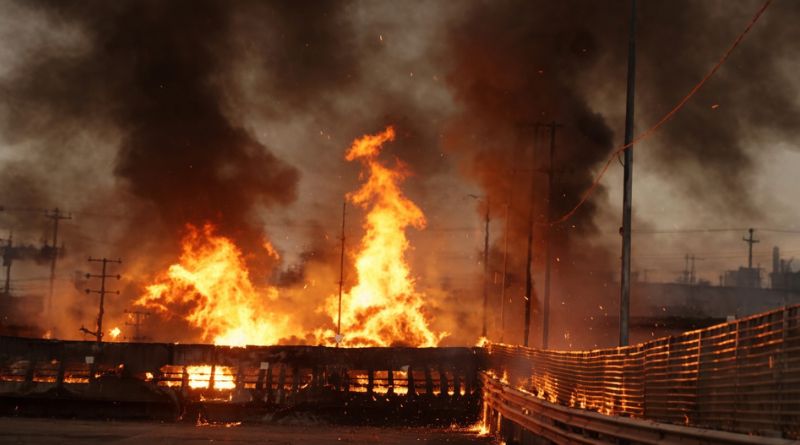
In a sharp escalation of tensions in the Middle East, the United States and Israel launched coordinated airstrikes on targets inside Iran early Saturday, marking one of the most serious confrontations between the countries in decades. According to U.S. officials, the strikes were part of a broader effort to weaken Iran’s military capabilities and curb what Washington and its allies describe as threats linked to missile development, regional proxy forces, and nuclear-related infrastructure. The operation reportedly targeted facilities connected to the Islamic Revolutionary Guard Corps (IRGC), along with missile installations, air-defense systems, and other strategic sites across several provinces. Locations near Tehran, Isfahan, Qom, Kermanshah, and Karaj were among the areas mentioned in early reports.
Political leaders in Washington and Jerusalem portrayed the operation as a preventive step. U.S. President Donald Trump said the strikes were intended to address what he called “imminent threats,” while Israeli Prime Minister Benjamin Netanyahu argued the action was necessary to counter what Israel sees as a long-standing strategic danger from Iran’s military expansion. In the hours following the strikes, conflicting information quickly circulated. Some Israeli reports suggested the operation may have targeted locations connected to Iran’s senior leadership, raising speculation about the safety of Supreme Leader Ali Khamenei. Iranian state media, however, rejected those claims and said he remained unharmed.
Iran responded swiftly. Officials reported waves of ballistic missiles and drones launched toward Israel, along with attacks aimed at U.S. military installations across the region. Activity was reported near bases in Qatar, the United Arab Emirates, Bahrain, Kuwait, and other locations hosting American forces. Tensions also spread to the Persian Gulf. Iranian naval forces reportedly warned commercial vessels operating near the Strait of Hormuz that passage could be unsafe. Because a large share of the world’s oil supply moves through this narrow waterway, any disruption raises concerns about global energy markets and economic stability. As governments around the world monitor the situation, analysts warn that the period immediately after a major escalation is often the most unpredictable—when decisions made in hours can shape the trajectory of a wider conflict.