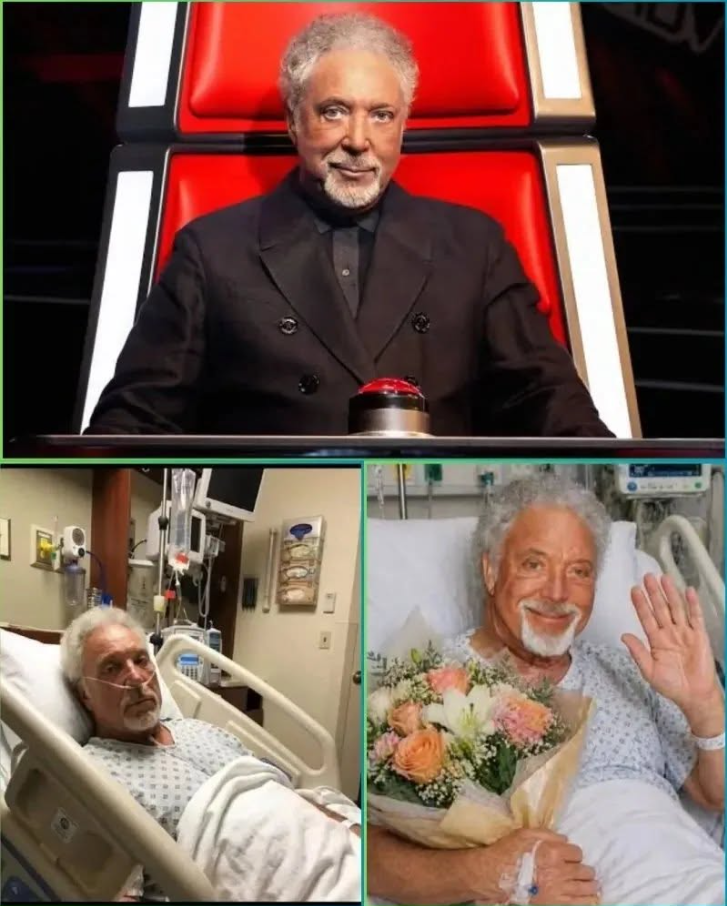

For more than six decades, Sir Tom Jones has captivated audiences with one of the most powerful voices in music. But behind the confidence, energy and unmistakable stage presence of the legendary Welsh singer lies a deeply frightening experience. According to a recent account, the 86-year-old star became seriously ill during his American tour, spending approximately a week in a Los Angeles hospital, including two days in intensive care. What began as flu-like symptoms reportedly developed into pneumonia, leaving the singer struggling to breathe and fearing that his extraordinary life might be approaching its end. Yet just weeks later, he was back doing what he loves most: standing before an audience and singing.
For fans who have followed his remarkable journey from the streets of Pontypridd to the world’s biggest stages, the story is an emotional reminder that even the most enduring entertainers are not immune to serious illness.
Jones has spent much of his life under the spotlight, performing for generations of listeners who have grown up with his music.
His voice has become synonymous with strength, passion and an extraordinary ability to connect with an audience.
But the reported health crisis revealed a different side of the legendary performer.
One marked by uncertainty, vulnerability and the frightening possibility that he might never return to the stage.
The account describes an illness that forced him to confront his own mortality before making a meaningful return to performing.
 A frightening illness that changed everything
Sir Tom Jones was reportedly in the United States for the American leg of his Come Gather Round tour when his health suddenly deteriorated.
At first, the symptoms appeared to resemble a severe case of flu.
For a performer accustomed to the demands of touring, feeling unwell can be particularly concerning.
Concert schedules involve travel, rehearsals, soundchecks and the physical effort of delivering a live performance.
Even a relatively minor illness can interfere with those commitments.
But in Jones’s case, the situation reportedly became far more serious.
The illness developed into pneumonia, a potentially dangerous infection that affects the lungs and can make breathing extremely difficult.
For an 86-year-old performer, such a diagnosis naturally carries particular concern.
According to the supplied report, his condition became serious enough to require hospital treatment in Los Angeles.
What had begun as an illness during a tour became an experience that reportedly left him wondering whether he would survive.
 A week in hospital and two days in intensive care
The account states that Jones spent approximately a week at UCLA Medical Center in Los Angeles.
Two of those days were reportedly spent in intensive care.
For someone whose life has been defined by movement, music and performance, the experience of being confined to a hospital bed would represent a dramatic change.
Instead of preparing to walk onto a stage, the singer was receiving medical attention.
Instead of hearing the applause of an audience, he was surrounded by the realities of hospital treatment.
The report also describes him struggling to breathe before receiving urgent care.
Breathing difficulties can be particularly frightening because they affect one of the body’s most basic functions.
Pneumonia can cause inflammation in the lungs, and severe cases may require close monitoring and additional respiratory support.
The exact medical treatment Jones received has not been detailed in the supplied account.
Nevertheless, the reported period in intensive care illustrates the seriousness of the situation.
For fans, the thought of such a familiar and energetic performer facing a major health emergency is deeply unsettling.
“I thought this was the end”
Perhaps the most emotional aspect of the story is the reported admission that Jones genuinely feared he might die.
The supplied account describes him recalling that his condition had become so serious that he believed his life could be nearing its end.
For a performer who has experienced extraordinary professional success, such a moment would place everything into a different perspective.
Awards, record sales and sold-out concerts can seem less important when someone is struggling with a serious illness.
The immediate concern becomes survival.
The possibility of seeing loved ones again.
And the hope of recovering enough to return to ordinary life.
The phrase “I thought this was the end” captures the fear described in the report, although the complete transcript of Jones’s alleged remarks has not been provided.
What makes the story particularly moving is the contrast between the public image of a seemingly unstoppable entertainer and the vulnerability associated with serious illness.
For decades, Jones has projected confidence on stage.
Yet the experience described here reminds audiences that age and illness can affect even the most celebrated figures.

 The emotional moment he returned to Los Angeles
According to the report, Jones returned to the Greek Theatre in Los Angeles on Wednesday, 4 November.
The concert was described as a particularly meaningful occasion following his hospitalisation.
For an artist whose career has revolved around live performance, returning to the stage after a serious illness can represent far more than fulfilling a professional commitment.
It can symbolise a return to normality.
A chance to reconnect with audiences.
And an opportunity to do something that may have seemed uncertain during the most frightening moments of recovery.
The account states that Jones addressed the audience about his recent health problems.
Rather than treating the experience as an ordinary interruption to his schedule, he reportedly spoke about how deeply it had affected him.
Such an admission would offer listeners a rare glimpse into the personal challenges behind the public performance.
It would also help explain why the concert carried such emotional significance.
For those in attendance, seeing the singer return after a period of serious illness would have added another dimension to the evening.
 Gratitude for the people who helped him recover
The report says Jones expressed gratitude towards the doctors and medical staff involved in his treatment.
That acknowledgement is an important part of the story.
Serious pneumonia can require coordinated care from medical professionals who monitor breathing, infection and overall recovery.
Hospital teams may include doctors, nurses, respiratory specialists and other healthcare workers.
For patients, the support provided during such an illness can be essential.
The supplied account does not specify which treatments Jones received or identify individual members of his medical team.
But it does describe his appreciation for those who cared for him.
For someone who has spent decades receiving applause from audiences, the experience of depending on others during a medical emergency may have been especially significant.
It is a reminder that recovery from serious illness is rarely an individual achievement alone.
It often depends on professional care, patience and support.
Concerts postponed as fans waited for news
The illness reportedly forced Jones to postpone scheduled performances in Los Angeles and San Diego.
For fans who had been looking forward to seeing him live, the changes would naturally have been disappointing.
But a serious medical problem leaves little room for the demands of a concert schedule.
Performing requires physical stamina, particularly for a singer known for his powerful vocal delivery.



A respiratory illness can make singing difficult because breath control is fundamental to vocal performance.
Jones’s reported breathing difficulties therefore had implications beyond his general health.
They directly affected the physical ability on which his career depends.
Postponing concerts in such circumstances allows an artist to prioritise recovery rather than risk further strain.
The report does not provide a complete timeline of every affected performance.
However, it describes a period of uncertainty before the singer was able to return.
Why returning to music mattered so much
One of the most striking elements of the account is Jones’s reported determination to perform again.
Even while receiving hospital treatment, he was said to be thinking about returning to the stage.
For many artists, music is more than a profession.
It becomes an essential part of their identity.
That is especially true for someone who has spent more than sixty years entertaining audiences.
Jones began building his international career during the 1960s.
Since then, his life has been shaped by recording, touring, television appearances and countless live performances.
The stage is a place where he has spent an extraordinary amount of time.
It is also where he has formed a lasting relationship with his audience.
The desire to return after illness is therefore understandable.
For Jones, performing has remained a central part of his public life well into his eighties.
His reported return to Los Angeles reflected that enduring commitment.
From Pontypridd to international superstardom
Sir Tom Jones’s story began in Pontypridd, South Wales.
Born Thomas John Woodward in 1940, he grew up far from the international stages that would eventually become his professional home.
His powerful voice helped transform him into one of Britain’s most recognisable singers.
His breakthrough came during the 1960s, when It’s Not Unusual became a defining hit.
The song introduced audiences to a performer with an unmistakable sound.
Jones combined vocal power with charisma, dramatic delivery and a commanding stage presence.
He went on to record a succession of successful songs.
Among them were What’s New Pussycat?, Delilah, Green, Green Grass of Home and She’s a Lady.
His music reached listeners across generations.
And his career continued long after many performers from the same era had retired.
That longevity is part of what makes the recent health story so affecting.
Jones has become a symbol of endurance in the entertainment industry.
But even an extraordinary career cannot remove the physical realities of ageing.
A voice that has connected generations
Few singers can claim the kind of longevity that Jones has achieved.
His songs have been played at weddings, celebrations, family gatherings and major public events.
His performances have introduced younger listeners to music first released decades before they were born.
Over time, he has demonstrated an ability to adapt without losing the distinctive sound that made him famous.
His voice remains central to his identity.
And that is why an illness affecting his breathing carries particular emotional weight.
Singing is an intensely physical activity.
It requires control, strength and coordination.
A performer may appear effortless on stage, but producing a powerful vocal performance demands considerable effort.
For someone recovering from pneumonia, regaining confidence in those abilities can be an important part of returning to work.
The supplied account does not describe his detailed rehabilitation.
But it does portray his return to performing as a meaningful milestone.
The reality of facing mortality at 86
At 86, Jones has lived through decades of personal and professional change.
He has experienced the transformation of the music industry.
He has seen musical trends emerge, disappear and return.
He has performed for audiences whose parents and grandparents may also have listened to his songs.
But serious illness can create a moment of reflection regardless of a person’s achievements.
When someone fears that their life may be ending, everyday priorities can suddenly take on new importance.
The possibility of another conversation with a loved one.
Another morning at home.
Another opportunity to experience something familiar.
Or, in Jones’s case, another chance to stand before an audience.
The reported admission that he feared for his life suggests that the illness was not merely a temporary inconvenience.
It was described as a frightening personal experience.
And that gives his return to the stage a deeper emotional meaning.
A difficult period of change in his television career
The health scare was also reported during a period of professional change for Jones.
According to the supplied account, he revealed in September that ITV had decided not to retain him as a full-time coach on The Voice UK.
The report states that he was disappointed by the decision.
Jones has been closely associated with the singing competition, where his experience and musical knowledge have made him a recognisable presence.
As a coach, he has offered guidance to aspiring performers hoping to establish their own careers.
His role has allowed audiences to see a different side of him.
Rather than being the star at the centre of a concert, he has often focused on encouraging other singers.
That mentoring relationship has become an important part of his later television career.
The reported change in his role therefore represented another significant development.
However, it should not be assumed that the television decision had any connection to his subsequent illness.
The supplied information does not establish such a link.
A moment of pride amid the uncertainty
Despite the reported disappointment surrounding his television role, the account also describes a positive moment.
Jones’s contestant Cate McHugh was said to have won the 2026 series of The Voice UK.
For a coach with decades of experience, helping a younger performer achieve success can be deeply rewarding.
It offers an opportunity to pass on knowledge gained over a lifetime.
Jones’s own career began long before modern television talent competitions became popular.
He knows the demands of live performance, recording and public attention.
Those experiences can provide valuable guidance to singers at the beginning of their journeys.
The reported victory therefore added a celebratory note to an otherwise challenging period.
It also reinforced the importance of his contribution to music beyond his own performances.
Why fans find the story so emotional
The thought of Sir Tom Jones facing a life-threatening illness is unsettling because his presence has been so constant.
For many people, his music is connected to memories of earlier decades.
His songs may remind listeners of their childhoods.
Of family celebrations.
Of loved ones who introduced them to his records.
Or of concerts they attended many years ago.
As a result, concern for his health can feel deeply personal.
The singer represents more than a collection of hit records.
He is part of the cultural history of several generations.

When a performer with such a long career experiences serious illness, audiences are reminded that the artists who have accompanied their lives are growing older too.
That recognition can bring a mixture of gratitude, sadness and admiration.
And it can make a successful return to performing feel especially meaningful.
The importance of recovery after serious illness
Although the report describes Jones’s return to the stage, recovery from pneumonia can vary considerably between individuals.
Some people recover relatively quickly.
Others experience lingering fatigue, breathlessness or reduced stamina.
Age, the severity of the infection and any existing medical conditions can influence recovery.
For that reason, a return to public performance should not automatically be interpreted as proof that every aspect of someone’s health has returned to its previous state.
The supplied account does not provide detailed medical follow-up information.
It would therefore be inappropriate to make specific claims about Jones’s long-term prognosis.
What the story does describe is a performer who was able to resume singing after a frightening hospital stay.
That is an encouraging development within the account.
But his future health and touring commitments remain matters for Jones and his medical advisers.
A remarkable determination to keep performing
Throughout his career, Jones has repeatedly demonstrated a commitment to music.
He has continued recording and performing long after reaching an age at which many entertainers choose to retire.
His enthusiasm for live audiences has remained a defining characteristic of his public image.
That dedication is particularly striking because the music industry has changed so dramatically since his early success.
Yet Jones has remained relevant.
He has continued to attract attention from listeners who appreciate both his classic hits and his later work.
His reported return to the Greek Theatre after hospitalisation fits into that larger story of persistence.
But it is important not to romanticise serious illness.
Recovery requires care and appropriate medical treatment.
Determination alone cannot replace those necessities.
The encouraging aspect of the account is that Jones reportedly received hospital care, recovered sufficiently and was able to return to an activity that has shaped his life.
An emotional reminder that legends are human
For decades, audiences have seen Jones as a larger-than-life figure.
His commanding voice and confident performances have helped create that image.
But the reported pneumonia battle reveals a more vulnerable side of the performer.
Someone who became seriously unwell.
Someone who required intensive medical attention.
And someone who reportedly feared that he might not survive.
These experiences are not unique to celebrities.
Families across the world know the anxiety that accompanies a serious illness.
They understand the uncertainty of waiting for medical updates.
They know the relief that can come when a loved one begins to recover.
That shared human experience is part of why Jones’s story resonates.
Behind the fame is a person confronting the same fundamental uncertainties that affect everyone.
What the future may hold for Sir Tom Jones
At 86, Jones has already achieved more than most performers could imagine.
His career spans generations.
His recordings remain familiar.
And his reputation as one of Britain’s great vocalists is firmly established.
Whether he continues touring extensively or eventually reduces his schedule is a decision that belongs to him.
The reported health crisis may naturally prompt questions about his future.
But there is no basis in the supplied account for claiming that he has announced his retirement.
Nor does the report establish that he intends to stop performing.
On the contrary, it describes his determination to return to music.
That makes the alleged comeback concert particularly meaningful.
For the moment, the story is not one of a confirmed farewell.
It is one of a serious illness followed by a reported return to the stage.
“I THOUGHT THIS WAS THE END…” — A frightening chapter in an extraordinary life
Sir Tom Jones has spent more than six decades building one of the most recognisable careers in music.
His voice has entertained millions.
His songs have become classics.
And his performances have created memories for audiences around the world.
But the recent account of his pneumonia battle describes a moment when all of that seemed uncertain.
A week in hospital.
Two days in intensive care.
Difficulty breathing.
And the frightening possibility that he might never perform again.
Yet the story also describes a return to the stage in Los Angeles, where Jones reportedly reflected on the experience and expressed gratitude to those who helped him recover.
SIR TOM JONES, 86, REPORTEDLY FEARED FOR HIS LIFE DURING A TERRIFYING PNEUMONIA BATTLE — BUT AFTER A WEEK IN HOSPITAL, THE LEGENDARY WELSH SINGER MADE AN EMOTIONAL RETURN TO THE STAGE.
His extraordinary career has always been defined by music.
And the account of his recovery offers another reminder of how much performing continues to mean to him.
For fans, the most moving part of the story may be the thought that a singer whose voice has accompanied so many important moments in their lives was able to sing again after such a frightening experience.
Sir Tom Jones has given the world more than sixty years of unforgettable music. Which of his songs means the most to you, and what message would you like to send him? Share your memories and good wishes in the comments.