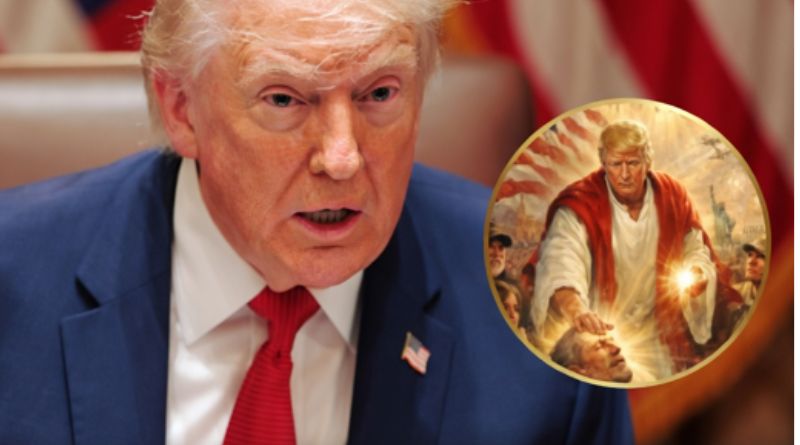
Donald Trump has recently become the focus of renewed political and online discussion following the circulation of an AI-generated image he shared on his social media platform, Truth Social, which sparked widespread debate over its religious symbolism and interpretation.
The image drew significant attention due to its stylized depiction of Trump in a Christ-like healing role, prompting mixed reactions across political, cultural, and religious communities online.
The controversy emerged shortly after Trump posted a separate message criticizing Pope Leo XIV, in which he used strong language describing the pope as “weak” on crime and “terrible” on foreign policy.
He later shared the AI-generated image without providing any explanation, which contributed to confusion and intensified public debate over its intended meaning.
The illustration shows Trump dressed in flowing white and red robes, placing his hand on an elderly man lying in a hospital bed in what appears to be a healing gesture.
Observers noted similarities between the scene and traditional religious depictions of Jesus Christ healing the sick, which amplified discussion and interpretation among viewers.
The background includes figures such as medical staff, soldiers, and civilians, who appear to be observing the moment in a reverent or emotional manner.
It also contains symbolic elements associated with American identity, including imagery resembling national landmarks, flags, and other patriotic motifs.
Additional details reportedly include eagles, aircraft, and glowing atmospheric effects, contributing to a highly stylized and dramatic visual tone.
Because the image was AI-generated, interpretations vary widely among viewers, with some describing it as symbolic or satirical and others viewing it as inappropriate or provocative.
One point of controversy involved unverified social media claims that the patient in the image resembled a well-known public figure, though this has not been confirmed.
Online reactions spread quickly across platforms, with users expressing both criticism and support reflecting sharply divided interpretations of the post.
Critics argued that the religious imagery was inappropriate for a political figure, while supporters said it should be understood as symbolic political expression.
Several commentators and religious writers expressed concern that such imagery risks blurring boundaries between faith and political messaging.
Political analysts noted that Trump has previously used AI-generated and highly stylized imagery in his communication strategy, often generating similar debate.
They added that religious symbolism tends to generate stronger reactions than other forms of political visual content.
Experts in media and communication said AI-generated political imagery raises new challenges around interpretation, intent, and authenticity in digital discourse.
The absence of an official explanation from Trump has left interpretation largely to the public and media commentators.
As a result, discussion continues across news outlets and social media platforms, with no consensus on intent or meaning.
Overall, the incident reflects broader tensions between political expression, religious sensitivity, and modern digital communication tools.
As discussions evolve, analysts suggest that similar controversies are likely to become more common as AI-generated imagery becomes increasingly accessible and integrated into political communication strategies. The ease of creating highly realistic or symbolic visuals through artificial intelligence has introduced new dynamics in how political messages are crafted and interpreted. In this case, the lack of clarifying context has amplified speculation, with audiences projecting different meanings based on personal beliefs and political alignment. Communication experts argue that this environment can intensify polarization, as visual content often spreads faster and is interpreted more emotionally than written statements. The situation therefore highlights the growing need for media literacy in understanding AI-generated political content.
Ultimately, the episode demonstrates how a single AI-generated image can rapidly become a focal point of national debate, especially when it combines political identity, religious symbolism, and emotionally charged visual storytelling. While some observers interpret such content as artistic or rhetorical expression, others view it as potentially inappropriate given the sensitivity of religious themes. The differing reactions underscore how fragmented interpretations of digital media have become in the current political environment. Without clear explanatory context from the original source, meaning is often constructed by audiences rather than defined by intent. As AI tools continue to evolve, experts anticipate that similar controversies will challenge public discourse, requiring ongoing conversations about ethics, communication, and responsibility in the use of synthetic media, especially in politically sensitive global contexts moving forward globally.