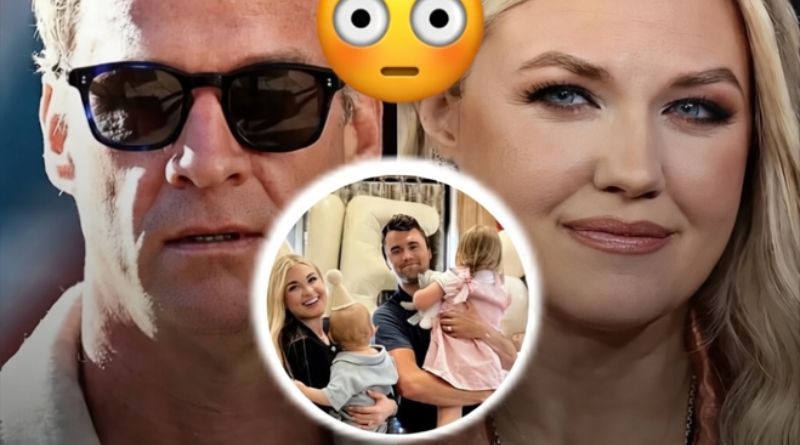
There is no credible reporting confirming that Erika Kirk has entered a new romantic relationship. What is documented tells a very different story. In the months following her husband’s death, she has continued to grieve publicly, stepped into a leadership role at Turning Point USA, spoken about raising their two young children, and remained actively engaged in the legal case against the man accused of killing him.
That distinction matters. Narratives about a widow “moving on too quickly” often take hold even when the underlying claim is weak or unsupported. In Erika Kirk’s case, recent coverage has focused not on a new relationship, but on a woman navigating profound loss while under intense public scrutiny. She has been portrayed as a grieving spouse, a mother, and a figure suddenly thrust into a visible leadership position during a deeply traumatic period.
The more accurate way to frame this story is not through speculation about her personal life, but through the public’s tendency to judge how grief should look. Mourning is often treated as if it must follow a visible script—one that demands a certain level of sorrow, silence, and duration to be considered acceptable. Yet grief rarely unfolds in ways that satisfy public expectations. It is uneven, deeply personal, and often impossible to measure from the outside.
There is also a clear double standard at work. Widows are frequently judged more harshly than widowers. What might be seen as resilience or emotional strength in a man is often interpreted as disloyalty in a woman. This imbalance reveals more about cultural attitudes than it does about the individual being scrutinized.
In Erika Kirk’s case, the public record continues to reflect someone closely tied to her husband’s memory and legacy. She has spoken openly about her loss, her children, and her pursuit of justice. These are not the actions of someone treating grief lightly, but of someone enduring it while the world watches.
Unless there is a credible, primary source confirming a new relationship, it is misleading to build a narrative around that claim. A more honest approach is to recognize that moving forward after loss—whenever it happens—is not a betrayal, but a deeply human process.