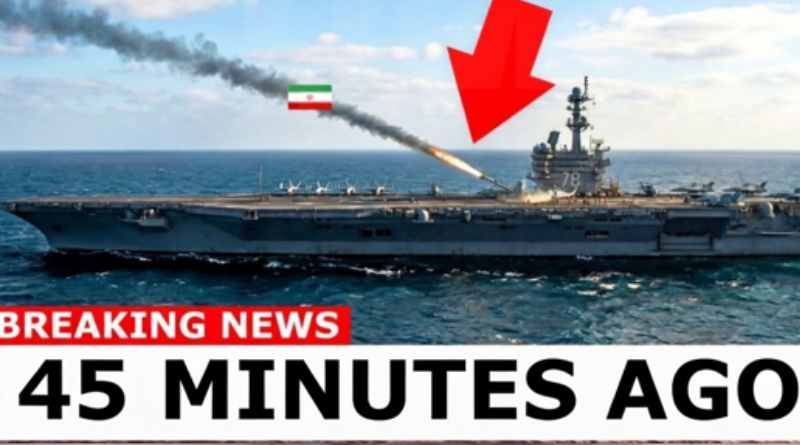
In a dramatic and high-stakes scenario, tensions in the Arabian Sea escalate into a near-catastrophic confrontation. At the center of this fictional event is the USS Gerald R. Ford, the most technologically advanced aircraft carrier in the United States Navy. What begins as a routine morning quickly transforms into a life-or-death situation as the ship’s missile detection systems erupt with urgent alarms.
Eight incoming missiles have been launched toward the carrier. At first glance, they appear identical—fast-moving, highly sophisticated, and difficult to distinguish. However, hidden among them is a single lethal threat: a Khorramshahr missile warhead carrying approximately 1,500 kilograms of high explosives. The remaining seven are decoys, carefully designed to confuse and overwhelm defensive systems.
The carrier’s primary defense, the Aegis Combat System, activates immediately. Designed to track and intercept multiple threats simultaneously, Aegis begins launching interceptor missiles in rapid succession. Each interceptor is tasked not only with destroying a target but also with determining whether that target is real or a decoy. The complexity of the situation intensifies as the system struggles to differentiate between the incoming objects.
As seconds pass, tension aboard the carrier mounts. Interceptors are fired one after another, but the number available is finite. The crew watches anxiously as the count dwindles. Then, a critical moment arrives: the interceptor inventory is exhausted. Despite the system’s best efforts, two missiles remain on course toward the ship.
In the midst of this crisis, Lieutenant Rachel Webb, a vigilant and highly trained officer, notices something unusual. While monitoring the incoming tracks, she detects a minute discrepancy—a 0.3 percent variation in the exhaust plume of one missile. It is an almost imperceptible difference, something that could easily be dismissed under pressure. Yet Webb recognizes its potential significance.
At just 51 seconds into the engagement, she flags the object, designated “contact 6,” as a possible real threat. While her superiors remain focused on the overall tactical picture and broader defensive coordination, Webb concentrates intensely on this single anomaly. For the next 14 minutes, she continues to monitor it, fully aware that her judgment could influence the outcome of the entire encounter.
This scenario highlights a key challenge in modern naval warfare: the increasing use of deception. By deploying decoys alongside an actual warhead, an attacker can complicate defensive responses and force systems like Aegis to make difficult decisions under extreme time constraints. Even the most advanced technology can be strained when faced with multiple, nearly identical threats.
Missiles such as the Khorramshahr, with ranges exceeding 2,000 kilometers and the ability to carry various payloads, represent a significant evolution in military capability. When combined with decoy tactics, they create a layered threat that tests not only hardware but also human judgment and decision-making processes.
Despite the sophistication of automated defense systems, this hypothetical event underscores the continued importance of the human element. Lieutenant Webb’s ability to identify a subtle inconsistency demonstrates that technology alone is not enough. Human perception, training, and intuition remain critical components of effective defense. In high-pressure situations, where decisions must be made in seconds, the ability to interpret small details can prove निर्णतive.
The broader implications of such a scenario are significant. As missile technology continues to advance, naval forces around the world must adapt their strategies and defenses accordingly. Questions arise about interceptor capacity, system reliability, and the integration of human oversight with automated processes. The balance between machine efficiency and human judgment becomes increasingly important.
If the USS Gerald R. Ford were to successfully defend against this type of attack, it would reinforce confidence in current naval defense systems and demonstrate the effectiveness of coordinated human and technological responses. On the other hand, a failure to intercept the missiles could have far-reaching consequences, potentially shifting regional power dynamics and encouraging adversaries to further develop similar tactics.
Ultimately, this fictional scenario serves as a powerful illustration of the complexities of modern warfare. It emphasizes the interplay between advanced technology, strategic deception, and human decision-making under pressure. While the USS Gerald R. Ford represents the pinnacle of naval engineering, this scenario reminds us that no system is infallible.
In an era of rapidly evolving threats, success depends not only on technological superiority but also on vigilance, adaptability, and the ability to recognize critical details when they matter most.