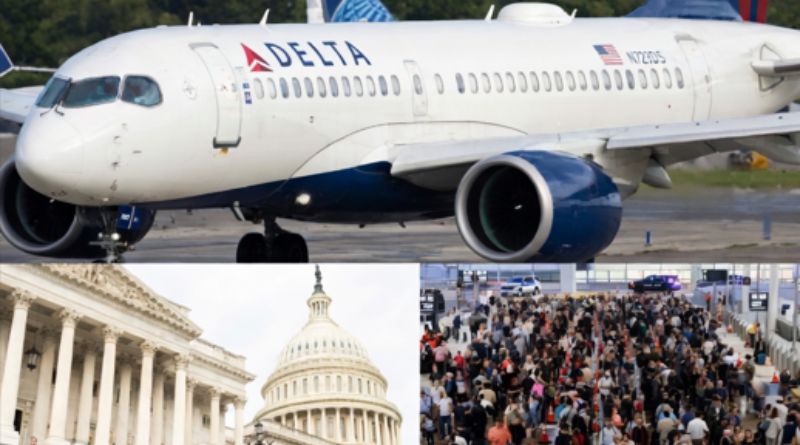
During the government shutdown, airport security across the United States did not collapse—but the pressure on the system became increasingly visible. Workers from the Transportation Security Administration (TSA) continued reporting for duty, even as paychecks were delayed. Their commitment kept airports functioning, but the strain slowly surfaced. With fewer staff available, security lines grew longer, wait times increased, and tension among travelers steadily rose.
Amid this backdrop, a quieter shift took place.
At the same time, Delta Air Lines made a notable internal adjustment. The airline removed special airport privileges that had long been extended to members of Congress. These perks included expedited assistance, escorts through terminals, and priority-style handling designed to streamline their travel experience.
There was no public announcement and no formal explanation—just a subtle change in practice.
As a result, lawmakers found themselves moving through airports much like any other passenger. They waited in standard TSA lines, dealt with the same delays, and encountered the same unpredictability that ordinary travelers had been facing throughout the shutdown.
Delta described the move simply as a resource decision, a necessary step during a time when operations were under strain. With staffing and logistics stretched thin, prioritizing efficiency across the board became essential.
Still, the timing carried an unspoken message.
The shutdown highlighted a broader reality: when critical systems are pushed to their limits, the effects can reach everyone. Not through policy changes or deliberate attempts at fairness, but because the system itself begins to tighten under pressure.
In this case, there was no dramatic failure—no widespread chaos or breakdown. Airports continued to operate, and security lines continued to move.
But the experience shifted.
It became a moment, however brief, where the gap between everyday travelers and those in positions of power narrowed—driven not by intention, but by circumstance.