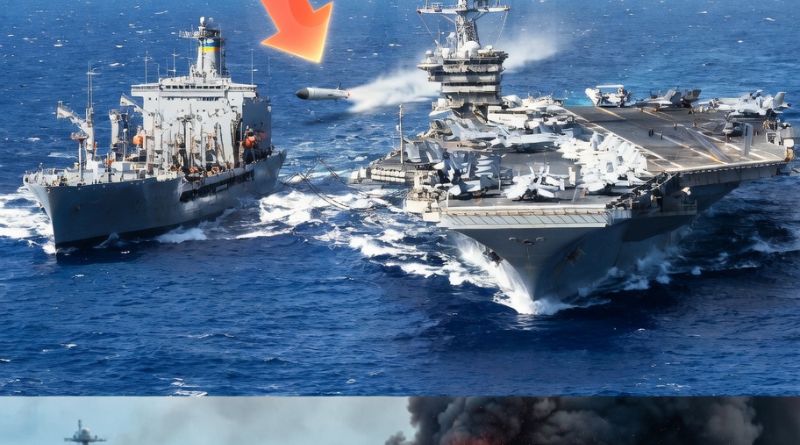
The Vulnerabilities and Defenses of a U.S. Supercarrier at Sea U.S. Navy aircraft carriers are among the most powerful symbols of military strength and technological prowess. Yet even these floating fortresses face moments of vulnerability, particularly during underway replenishment—the critical operation of refueling at sea. Naval analysts often refer to this period as the “death box,” when carriers are arguably at their most exposed. During refueling, a supercarrier such as the USS Gerald R. Ford is effectively stationary, tethered to a supply ship. While essential for maintaining extended naval operations, this moment creates a potential target for adversaries. The carrier’s defensive systems must operate at maximum efficiency, ready to counter any threat that arises during this precarious window.
Multi-Layered Defense Strategy
The U.S. Navy has developed a sophisticated, multi-layered defense network to protect carriers during these vulnerable operations. Each element plays a critical role in ensuring the safety of the vessel and its crew.
Electronic Warfare: One of the first lines of defense is advanced electronic warfare technology. These systems can jam enemy communications and radar, effectively creating a protective bubble around the carrier. Electronic warfare provides real-time intelligence, allowing the ship to anticipate threats and disrupt potential attacks before they can materialize.
Combat Air Patrol (CAP) Fighters: Nearby aircraft on combat air patrol are crucial for intercepting threats before they reach the carrier. Equipped with advanced radar and long-range missiles, these fighters can engage enemy aircraft at beyond-visual range. Their presence acts not only as a defensive measure but also as a deterrent, discouraging adversaries from attempting an attack.
Aegis Destroyers: Accompanying Aegis-equipped destroyers provide another vital layer of protection. These ships can simultaneously track and engage multiple targets, from missile strikes to drone swarms, giving the carrier strike group flexibility and resilience against evolving threats.
Emerging Threats
Modern naval operations face increasingly sophisticated dangers. Drone swarms are particularly concerning, as unmanned aerial vehicles can overwhelm traditional defenses. The Navy counters this risk through electronic warfare, anti-drone measures, and tactical coordination among the carrier strike group.
Hypersonic missiles—capable of exceeding Mach 5—present another significant challenge. Their extreme speed makes detection and interception difficult. To address this, the Navy has invested in advanced missile defense systems capable of tracking and neutralizing hypersonic threats, even while the carrier is in a vulnerable state.
Close-In Defense and Retaliation
If an attack penetrates outer defenses, the Phalanx Close-In Weapon System (CIWS) serves as the last line of protection. This automated, rapid-fire system can detect and destroy incoming threats at close range, providing a critical safeguard for the ship and crew.
In addition to defensive measures, the carrier strike group can retaliate decisively. With an array of strike capabilities, including airstrikes and missile launches, any attempt to attack a supercarrier would carry severe consequences. This retaliatory capacity reinforces deterrence, discouraging adversaries from exploiting moments like underway replenishment.
Conclusion
Refueling at sea is one of the most critical and vulnerable moments for a U.S. supercarrier. Yet through a combination of electronic warfare, combat air patrols, Aegis destroyers, advanced missile defense, and close-in weapon systems, the Navy maintains robust protection. The integration of these defenses ensures that carriers remain formidable, even in the face of evolving threats such as drone swarms and hypersonic missiles.
Understanding the intricacies of underway replenishment offers insight into modern naval strategy and highlights the Navy’s commitment to maintaining operational superiority. The next time a supercarrier sails the high seas, remember the intricate web of technology, personnel, and strategy that shields it—even during its most vulnerable moments.