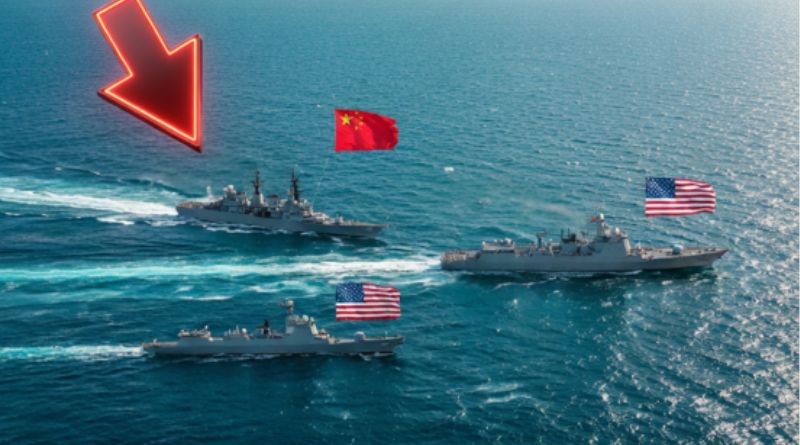
In the South China Sea, a routine naval operation nearly spiraled into a global crisis. A Chinese destroyer received orders to intercept the USS Nimitz, one of the world’s most powerful aircraft carriers. What followed was a tense standoff, a dangerous display of military brinkmanship where a single misstep could have triggered catastrophe. The South China Sea has long been a hotspot of geopolitical tension. China, Vietnam, the Philippines, and other nations assert overlapping territorial claims, while the United States conducts regular naval operations to maintain freedom of navigation. These operations often provoke strong reactions from China, which views them as challenges to its sovereignty. The Nimitz incident is the latest example of this ongoing struggle for dominance.
The USS Nimitz, a Nimitz-class aircraft carrier, displaces over 100,000 tons and carries around 6,000 personnel. Equipped with advanced aircraft, including F/A-18 Super Hornets, and a wide array of weaponry, the carrier projects unmatched U.S. naval power. The Chinese destroyer, part of the People’s Liberation Army Navy, was armed with modern missiles and radar systems, prepared to assert China’s territorial claims. As the vessels closed in, tensions rose sharply. Fighter jets were launched, electronic warfare systems activated, and both sides maneuvered carefully, aware that a single miscalculation could escalate into open conflict. This was not simply a test of strength, but a complex game of tactics and signaling. Each move conveyed a message while avoiding outright war, a delicate balance in a high-stakes, three-dimensional chess match.
The incident highlights the critical role of communication and diplomacy. Established channels and military attachés likely helped prevent escalation, even as both sides demonstrated their capabilities. Experts compare such standoffs to a high-stakes poker game: projecting power without committing to conflict. This near-miss underscores the fragile balance of power in the South China Sea. It serves as a reminder of the ever-present risk of miscalculation, the importance of strategic restraint, and the need for continued dialogue. As U.S.-China tensions continue, the world watches closely, aware that even a routine encounter in these contested waters could have far-reaching consequences.