WASHINGTON — President Donald Trump has expressed high optimism that the United States and Iran can reach an agreement within the next week to extend their fragile ceasefire and reopen the strategically vital Strait of Hormuz, even as a fresh surge in fighting between Israel and Hezbollah in Lebanon threatens to complicate delicate diplomatic efforts.
In a telephone interview with ABC News on June 1, 2026, the president suggested that while a few sticking points remain, the two nations are close to a breakthrough that could dramatically ease the risk of conflict in the Persian Gulf.
“Looking good, looking good,” Trump told the network, describing the trajectory of the negotiations. He stressed, however, that while both sides are “getting what we need to get,” a final, signed agreement has not yet been formalized. “I think you’re talking about over the next week,” he added. “I still have to get a few more points.”
The president’s remarks offer a potential opening for de-escalation after weeks of military confrontation, maritime restrictions, and persistent uncertainty surrounding commercial shipping through the Persian Gulf. Yet the diplomatic outlook remains fragile, with regional hostilities threatening to undermine efforts to establish a more durable settlement.
Escalating Regional Hostilities Challenge Peace Push
The sudden push for U.S.–Iran de-escalation faces an immediate and complicated test: the escalating warfare between Israel and Iran-backed Hezbollah in Lebanon.
According to Trump’s account to ABC News, Iranian officials have expressed deep concern over the Israeli military campaign and its potential consequences for the broader ceasefire arrangement. Iran has indicated that Israeli operations in Lebanon threatened the diplomatic process, raising questions about whether negotiations with Washington could continue without a concurrent reduction in regional fighting.
To address these concerns, Trump revealed that he had directly intervened to halt the cross-border violence, calling on both Israeli Prime Minister Benjamin Netanyahu and Hezbollah to scale back their operations.
“We had a little glitch today, but I turned that one around very quickly, as you probably noticed earlier,” Trump told ABC News. “I spoke with Hezbollah, and I said no shooting, and I talked to Bibi [Benjamin Netanyahu] and said no shooting, and they both stopped shooting each other.”
While the president’s reported direct intervention has been viewed by some as an assertive effort to insulate the U.S.–Iran talks from the broader Middle Eastern conflict, regional analysts note that single-hand diplomatic calls do not, by themselves, ensure a lasting cessation of hostilities. Hostilities on the ground remain highly fluid, and the complex, often non-aligned interests of the multiple warring parties resist centralized diplomatic commands.
Trump described a potential peace agreement with Iran as a victory that could be “even better than a military victory,” though he conceded that overcoming decades of entrenched hostility is an uphill battle.
“It’s not a simple thing,” Trump acknowledged. “You’re talking about a real large country—them—very large country making a deal. Tremendous hostility, really. So it’s not an easy thing for them. It’s actually not easy from our standpoint either.”
The High Stakes of the Strait of Hormuz
At the heart of the current diplomatic push is the Strait of Hormuz, a narrow and heavily militarized maritime chokepoint connecting the Persian Gulf to the Gulf of Oman. As a conduit for roughly a fifth of the world’s daily oil and gas consumption, even temporary disruptions to the waterway can quickly destabilize global energy markets, inflate shipping insurance costs, and cascade through the international economy.
Under the framework described in current accounts, the negotiations would address maritime access, security arrangements, and the future of restrictions affecting Iranian economic activity. Washington has sought reliable, unhindered passage for commercial vessels and measures addressing concerns about Iran’s nuclear program. Tehran, meanwhile, has sought substantial relief from the economic pressure and maritime restrictions that have severely hindered its oil exports.
The precise terms of any proposed agreement, including inspection arrangements, sanctions relief, and the future of American naval restrictions, would need to be confirmed through official documentation or statements from both governments.
Although Trump expressed confidence that progress was possible, the outstanding issues suggest that significant, detailed negotiations remain before the two sides can formalize a comprehensive settlement.
A Fragile Path From Ceasefire to Lasting Peace
The latest diplomatic push followed earlier, unsuccessful efforts to end the conflict. Initial negotiations hosted by Pakistani mediators in April failed to produce a comprehensive peace agreement, leaving both Washington and Tehran facing ongoing military and economic friction.
Subsequent discussions focused on extending the temporary ceasefire and establishing workable protocols to reopen the Strait of Hormuz to global shipping. Yet disagreements over security guarantees, sanctions, and the sequencing of concessions continue to complicate the process.
For Washington, a lasting arrangement would need to address concerns about Iranian military capabilities, nuclear activities, and threats to regional shipping. For Tehran, meaningful economic relief and assurances concerning future military operations remain important considerations.
The two sides would also need to determine how compliance would be monitored and what consequences would follow if either party alleged violations—questions that are particularly important because a temporary reduction in fighting does not necessarily resolve the underlying disputes that contributed to the conflict in the first place.
Global Markets Watch Closely
The outcome of the negotiations has massive implications far beyond the Middle East. Energy importers, shipping companies, and financial markets closely monitor developments around the waterway, as previous spikes in regional tensions have historically driven up global oil prices and transportation costs.
A credible, verifiable agreement that restores predictable commercial transit would provide a welcome relief to the global economy. However, maritime operators and insurers will likely remain cautious, evaluating on-the-ground security conditions and the reliability of any proposed guarantees before fully adjusting their operations.
While President Trump’s optimistic timeline of a deal within the next week has raised expectations, diplomatic sources and military observers emphasize that a final, lasting settlement remains dependent on resolving complex technicalities and preventing a broader regional flare-up from shattering the progress made so far.
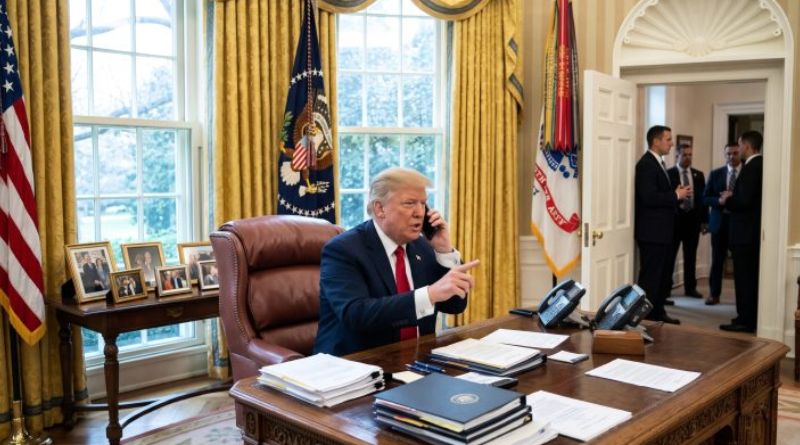
Oval Office High-Stakes Diplomacy
President Donald Trump engages in high-stakes phone negotiations from the Oval Office, aiming to secure a Persian Gulf ceasefire.