SUPREME COURT DELIVERS MAJOR RULING LIMITING HUMAN RIGHTS LAWSUITS AGAINST U.S. COMPANIES OVERSEAS
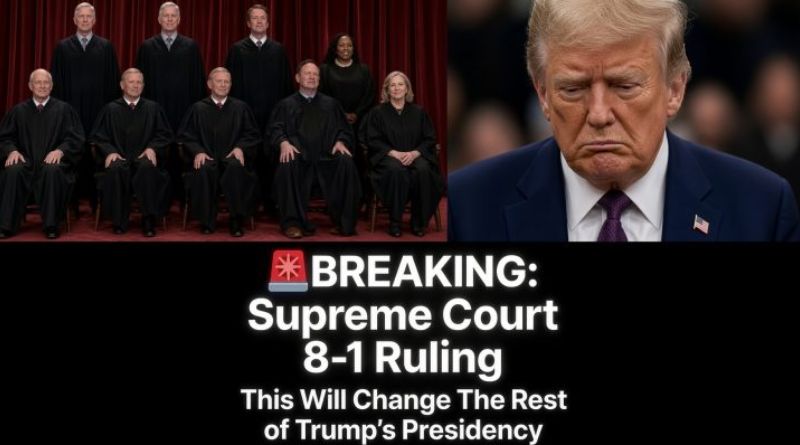
In a significant decision restricting the ability of foreign plaintiffs to pursue human rights claims against American businesses, the U.S. Supreme Court ruled 6-3 on Tuesday that overseas claimants cannot rely on the Alien Tort Statute or the Torture Victim Protection Act to hold U.S. companies responsible for allegedly assisting human rights violations committed abroad.
The decision in Cisco Systems, Inc. v. Doe (No. 24-856) substantially narrows the circumstances under which foreign individuals can bring lawsuits in American courts over U.S. corporations’ business relationships, technology sales, or commercial activities involving foreign governments.
Writing for the conservative majority, Justice Amy Coney Barrett explained that federal courts do not have the authority to create new private legal claims under the Alien Tort Statute of 1789. She also concluded that the Torture Victim Protection Act of 1991 does not authorize lawsuits based on secondary liability, including claims that a company aided or encouraged acts of torture.
Chief Justice John Roberts and Justices Clarence Thomas, Samuel Alito, Neil Gorsuch, and Brett Kavanaugh joined Barrett’s opinion.
Referring to the Supreme Court’s 2004 decision in Sosa v. Alvarez-Machain, Barrett wrote that the ruling ended the ability of federal courts to establish additional causes of action based on international legal standards. She further stated that although the Torture Victim Protection Act provides an explicit avenue for certain claims, its language does not extend liability to parties accused of aiding and abetting the underlying misconduct.
The case originated with a lawsuit filed by individuals who practiced Falun Gong, a spiritual movement prohibited by the Chinese government. The plaintiffs alleged that Chinese authorities subjected members of the movement to persecution, unlawful detention, and torture, claiming that technology supplied by Cisco Systems helped facilitate those abuses.
Their complaint focused on Cisco’s alleged involvement in developing and providing surveillance and networking technology associated with China’s “Golden Shield” project. The plaintiffs also accused the company’s senior executives of knowingly assisting the Chinese government’s human rights violations.
A federal district court initially rejected the lawsuit. However, the Ninth Circuit Court of Appeals later reinstated the claims, concluding that both federal statutes could support aiding-and-abetting lawsuits against American companies accused of knowingly contributing to violations of international law.
The Supreme Court has now overturned that decision, rejecting the legal foundation for the plaintiffs’ claims.
MAJORITY EMPHASIZES CONGRESS’S AUTHORITY AND SEPARATION OF POWERS
In explaining the ruling, Barrett emphasized the constitutional division of responsibilities among the branches of the federal government. She argued that creating private rights of action is primarily a responsibility of Congress, not federal judges.
The majority expressed concern that allowing courts to establish new claims based on changing international legal standards could interfere with decisions involving foreign relations and national policy. Those matters, the justices said, require the involvement of the political branches of government rather than independent judicial policymaking.
The court also distinguished between the two laws at issue. It described the Alien Tort Statute as a law granting federal courts jurisdiction rather than independently creating a broad right to sue. Regarding the Torture Victim Protection Act, the majority concluded that Congress had not included language establishing liability for those who merely assist another party’s unlawful conduct.
Under that interpretation, Cisco could not be held liable through the legal theories advanced by the plaintiffs.
BUSINESS COMMUNITY WELCOMES THE DECISION
The ruling represents a major legal victory for multinational corporations, particularly technology companies and manufacturers conducting business in international markets.
It also reflects arguments made by the federal government, whose Solicitor General supported Cisco during the Supreme Court proceedings. Government officials warned that allowing expansive lawsuits over overseas conduct could complicate diplomatic relationships, expose American interests to retaliatory legal action in foreign countries, and discourage U.S. companies from developing technologies for international markets.
Business organizations and corporate attorneys welcomed the decision, arguing that it provides greater certainty for companies operating across national borders.
For years, businesses have faced expensive lawsuits under the Alien Tort Statute involving allegations tied to actions taken by foreign governments. Corporate representatives have argued that companies should not automatically face liability for human rights abuses simply because their products or services were allegedly used by government authorities.
The Supreme Court’s decision significantly limits the ability of plaintiffs to pursue such cases under the two statutes involved.
LIBERAL JUSTICES REJECT THE MAJORITY’S INTERPRETATION
The court’s three liberal justices strongly disagreed with important parts of the majority’s reasoning, particularly its interpretation of the Torture Victim Protection Act.
Justice Sonia Sotomayor argued that the law’s wording should be understood broadly enough to cover individuals who intentionally assist or encourage torture. In her view, those who knowingly help carry out such abuses should not automatically escape responsibility because they did not personally commit the acts.
Sotomayor maintained that the statutory language supports claims against individuals who aid and abet torture and indicated that she would have upheld the Ninth Circuit’s decision on that issue.
Justice Ketanji Brown Jackson also issued a separate opinion concurring in part and dissenting in part, joined by Justice Elena Kagan. Although Jackson agreed with certain limits imposed on claims under the Alien Tort Statute, she argued that the Torture Victim Protection Act could reach parties that knowingly provide substantial assistance to state-sponsored torture.
The disagreement highlights a broader divide within the Supreme Court over the role of American courts in addressing human rights violations committed outside the United States.
Ultimately, the decision represents a significant setback for foreign plaintiffs seeking to hold U.S. corporations accountable for alleged assistance to human rights abuses overseas. It also reinforces the majority’s position that expanding federal civil liability through new legal claims is a responsibility for Congress, rather than something federal judges should establish on their own.